NATL: MELISSA - Aftermath - Discussion: Josh Morgerman video of Melissa is up

Moderator: S2k Moderators

Message
Author
User avatar
Teban54
Category 5
Category 5
Posts: 3787
Joined: Sat May 19, 2018 1:19 pm

Re: NATL: MELISSA - Hurricane - Discussion

#921 Postby Teban54 » Sun Oct 26, 2025 9:57 am

I could be reading too much into this, but...

A new burst of eyewall convection just appeared, immediately next to the "dry air channel" and near the convective blob. It's the strongest that I recall seeing this morning.

Could this be an attempt at shielding off the dry air and reintensifying?

Image
5 likes   

LarryWx
S2K Supporter
S2K Supporter
Posts: 6854
Joined: Sun Sep 07, 2003 2:04 pm
Location: GA

Re: NATL: MELISSA - Hurricane - Discussion

#922 Postby LarryWx » Sun Oct 26, 2025 9:58 am

You can tell that the NHC has an extra tough challenge right now considering it’s 10:57AM EDT and the 11AM just came out. It usually comes out by 10:45AM.
6 likes   
Personal Forecast Disclaimer:
The posts in this forum are NOT official forecasts and should not be used as such. They are just the opinion of the poster and may or may not be backed by sound meteorological data. They are NOT endorsed by any professional institution or storm2k.org. For official information, please refer to the NHC and NWS products.

USTropics
Professional-Met
Professional-Met
Posts: 2732
Joined: Sun Aug 12, 2007 3:45 am
Location: Florida State University

Re: NATL: MELISSA - Hurricane - Discussion

#923 Postby USTropics » Sun Oct 26, 2025 10:00 am

cheezyWXguy wrote:
USTropics wrote:
mrbagyo wrote:
Could that huge eastern blob of convection hindering the intensification? it appears too "heavy" for small Melissa to carry - like it's dragging the whole circulation not to spin faster.

sort of like a spinning top with uneven weight.

There are very intense storms that had strong spiral bands but their bands look "smooth". Melissa's doesn't look smooth at all


I've done a lot of research in this area, and it's definitely unique to this region like you stated. This all due to how the circulation around Melissa interacts with the prevailing easterly flow at this latitude and essentially establishes this convergence zone, or 'blob of convection' to the east of Melissa. Specifically, this is what is occurring:

1) There is a stationary band complex east of the system, or essentially confluence downshear (i.e., downshear direction is the southeast and northeast quadrant in this instance)
2) There is a surge in trade winds (see images below) coming from east -> west that interacts with this
3) We also have confluence downstream due to the vicinity of landmasses/terrain
4) Finally we have asymmetries due to mixing of drier air and these moist boundary layers

We can best see this by how the flow is completely different based on the level of the atmosphere we are in (and it doesn't impact intensity):

Surface (trade winds)
https://i.imgur.com/dDX27yf.png

Mid levels (700mb)
https://i.imgur.com/tQqTfCq.png

Upper levels (500mb)
https://i.imgur.com/mopPiDz.png

Near Troposphere (250mb)
https://i.imgur.com/xGsP9qV.png

It’s number 4 on your list that I’m suspecting to be the biggest culprit at the moment, although I’m sure it’s a combination of all like you said. Dropsondes from the southeastern half of the storm appear to be less saturated through the measured portion of the column than those from the northwestern half. Each time a band like this appeared the intensity leveled off, and after it weakened a new phase of intensification followed immediately after, which also lends credence to 1900hurricane’s lobing argument. When present, this feature seems to compete with the core for energy in some way.


I'm actually excited someone pointed out #4 (it's the least well known and researched factor here), and I do think it plays a critical role. Like most things in meteorology, there is a 'total budget' and we have to identify each contributing factor. I would be hesitant to say this is weakening the system (we went cat1 -> cat4 in like 12-14 hours afterall), but it definitely could limit moisture fluxes and create a temporary leveling off to intensity..
5 likes   

USTropics
Professional-Met
Professional-Met
Posts: 2732
Joined: Sun Aug 12, 2007 3:45 am
Location: Florida State University

Re: NATL: MELISSA - Hurricane - Discussion

#924 Postby USTropics » Sun Oct 26, 2025 10:18 am

Teban54 wrote:I could be reading too much into this, but...

A new burst of eyewall convection just appeared, immediately next to the "dry air channel" and near the convective blob. It's the strongest that I recall seeing this morning.

Could this be an attempt at shielding off the dry air and reintensifying?

https://i.imgur.com/05iLUyU.gif


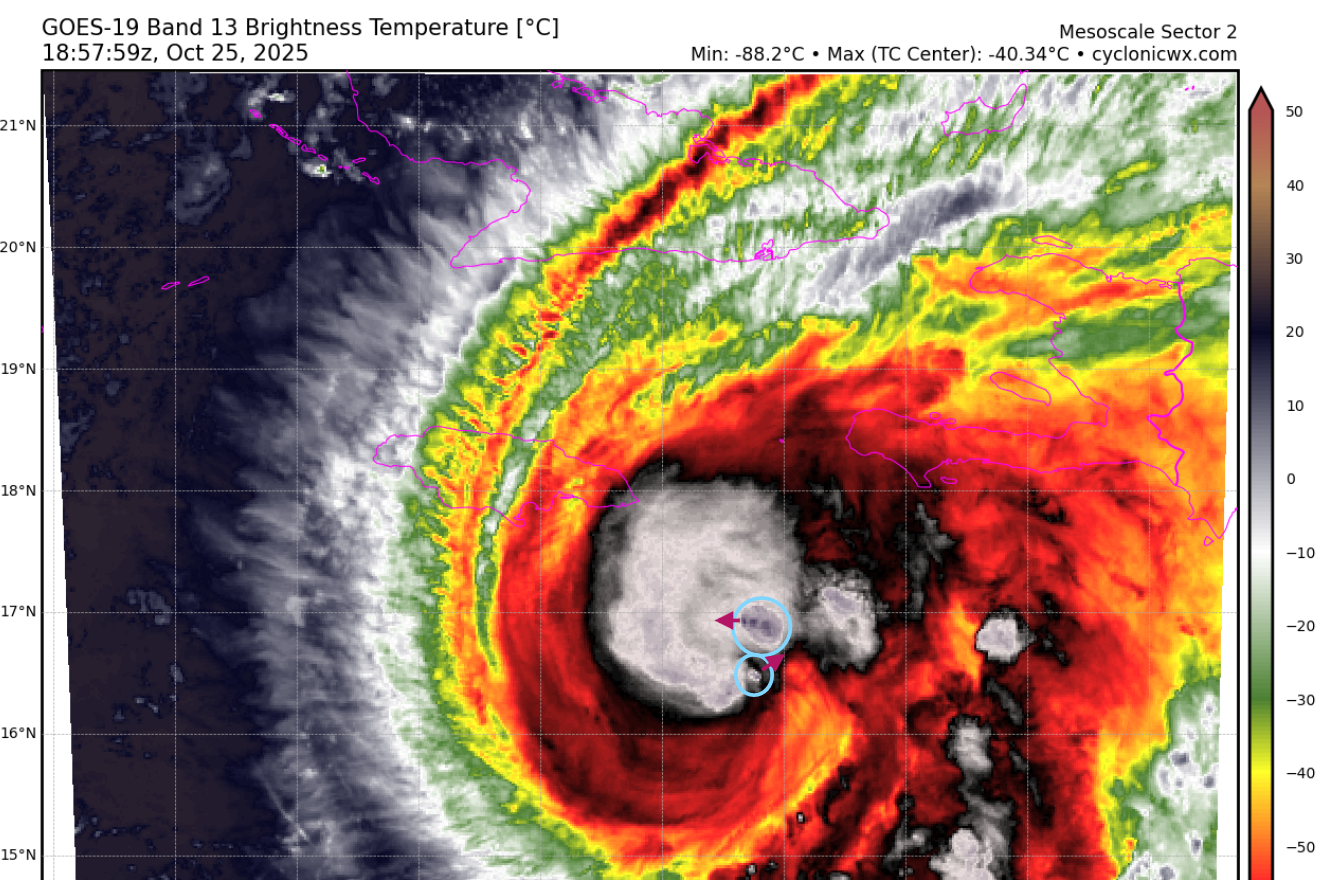
This is essentially a rinse and repeat of what occurred yesterday (quoted my post below, minus red VHT), and what I would expect to see occur today before/if Melissa begins another phase of RI. Like I was stating earlier, there have been concentric features on radar (and forecasted by HAFS-A) and this has created this eyewall melding scenario + some undercutting shear. It's prevented the eyewall from really contracting and is what has caused the level-off in intensity today imo.


USTropics wrote:
Iceresistance wrote:I think Melissa has gotten the dual VHTs, the arrows are direction. The northern VHT is moving fast
https://s12.gifyu.com/images/b3n30.png


Definitely some VHTs induced by the dry air interaction with the moist profile of Melissa's improving inner core:
Image

We have some dry air entrainment as Melissa starts to expand her convective envelope. Meanwhile, we have this moist inner core developing which has high equivalent potential temperature (PT). This creates these localized boundaries where inflow basically hits a wall, and we get enhanced convergence when the dry air hits the moist inflow (environment PT decreases, parcel buoyancy increases), and rapid ascent of warm, moist air takes place (our VHTs).

Each point where the dry air "hits" the moist core can initiate a separate updraft. The red VHT is optimally positioned so it has the largest vertical ascent initially. As teal continues to rotate towards the north, it gets more of those direct localized enhanced convergence effects. This is the response to balance two things: (1) the asymmetric structure that Melissa currently exhibits and (2) as a means to mix out the dry air intrusion before it reaches the inner core and disrupts the eyewall formation cycle.

https://i.imgur.com/zxBei8V.gif
1 likes   

User avatar
syfr
S2K Supporter
S2K Supporter
Posts: 223
Age: 106
Joined: Fri Oct 26, 2012 7:33 pm
Location: East Central NC

Re: NATL: MELISSA - Hurricane - Discussion

#925 Postby syfr » Sun Oct 26, 2025 10:22 am

LarryWx wrote:You can tell that the NHC has an extra tough challenge right now considering it’s 10:57AM EDT and the 11AM just came out. It usually comes out by 10:45AM.

I noticed the 30+ inches of rainfall on sections of Cuba.

Three FEET of rain is incredible to consider.
3 likes   
I'm not a meteorologist, I'm an electronics engineer. While I can probably fix your toaster oven, you're not going to learn about storms from me!

New Mexico had no hurricanes. Then I moved to NC right before Fran.....

User avatar
cheezyWXguy
Category 5
Category 5
Posts: 6242
Joined: Mon Feb 13, 2006 12:29 am
Location: Dallas, TX

Re: NATL: MELISSA - Hurricane - Discussion

#926 Postby cheezyWXguy » Sun Oct 26, 2025 10:22 am

Teban54 wrote:I could be reading too much into this, but...

A new burst of eyewall convection just appeared, immediately next to the "dry air channel" and near the convective blob. It's the strongest that I recall seeing this morning.

Could this be an attempt at shielding off the dry air and reintensifying?

https://i.imgur.com/05iLUyU.gif

I think this is true. Yesterday when this occurred, it seemed to follow this order of events:
1- prominent band forms, initially as a discrete blob, near the periphery of the cdo. Intensification levels off.
2- blob stretches into more of a classic band appearance, a moat between this band and the cdo becomes apparent.
3- new cells appear in the moat, eventually filling in as the original prominent band is gradually pushed farther away from the cdo and begins to lose influence.
4- new bursts begin to appear in the cdo/eyewall as the prominent band continues to weaken.
5- intensification resumes as eyewall bursts become stronger and band weakens further/dissipates.
If this is a repeatable sequence of events for today, I think we’re at the 4th point by now. We should watch to see if the band gets further removed from the core, new banding forms in the dry moat, and if new bursts continue to occur in the eyewall over the next couple hours.
6 likes   

User avatar
kevin
Category 5
Category 5
Posts: 2878
Age: 27
Joined: Wed Aug 28, 2019 4:35 am

Re: NATL: MELISSA - Hurricane - Discussion

#927 Postby kevin » Sun Oct 26, 2025 10:35 am

While the CDO is degrading on the NW side, a new strong burst of convection is wrapping around counter-clockwise from the previously weaker eastern side. If it fully wrapps around the CDO we could see continued intensification. Luckily, there's another recon plane nearing Melissa so we'll know all the details about her current state very soon.
1 likes   

User avatar
aspen
Category 5
Category 5
Posts: 9042
Joined: Sat Oct 12, 2019 7:10 pm
Location: Connecticut, USA

Re: NATL: MELISSA - Hurricane - Discussion

#928 Postby aspen » Sun Oct 26, 2025 10:36 am

I know we basically said this about last flight but this is a good time for recon to be heading in. Melissa seems to be picking back up after whatever halted its RI this morning. I wonder how much longer we’ll see this stair-stepping intensification.
1 likes   
Irene '11 Sandy '12 Hermine '16 5/15/2018 Derecho Fay '20 Isaias '20 Elsa '21 Henri '21 Ida '21

I am only a meteorology enthusiast who knows a decent amount about tropical cyclones. Look to the professional mets, the NHC, or your local weather office for the best information.

User avatar
Teban54
Category 5
Category 5
Posts: 3787
Joined: Sat May 19, 2018 1:19 pm

Re: NATL: MELISSA - Hurricane - Discussion

#929 Postby Teban54 » Sun Oct 26, 2025 10:39 am

cheezyWXguy wrote:
Teban54 wrote:I could be reading too much into this, but...

A new burst of eyewall convection just appeared, immediately next to the "dry air channel" and near the convective blob. It's the strongest that I recall seeing this morning.

Could this be an attempt at shielding off the dry air and reintensifying?

https://i.imgur.com/05iLUyU.gif

I think this is true. Yesterday when this occurred, it seemed to follow this order of events:
1- prominent band forms, initially as a discrete blob, near the periphery of the cdo. Intensification levels off.
2- blob stretches into more of a classic band appearance, a moat between this band and the cdo becomes apparent.
3- new cells appear in the moat, eventually filling in as the original prominent band is gradually pushed farther away from the cdo and begins to lose influence.
4- new bursts begin to appear in the cdo/eyewall as the prominent band continues to weaken.
5- intensification resumes as eyewall bursts become stronger and band weakens further/dissipates.
If this is a repeatable sequence of events for today, I think we’re at the 4th point by now. We should watch to see if the band gets further removed from the core, new banding forms in the dry moat, and if new bursts continue to occur in the eyewall over the next couple hours.

I think you're onto something. From the loop below, you can also see the new burst attempting to quickly turn itself into the new CDO (which has wrapped around 70% of the eyewall since the last frame of the loop). The blob is also showing clear separation from the core: Melissa's center has been slowly drifting W, while the blob remained somewhat stationary.

Image

This is quite similar to the huge burst yesterday that kickstarted the ERI (the loop here shows the whole process). For reference, the start of this loop was exactly when USTropics wrote the detailed explanation, which was quoted again upthread.

The main differences I see are:

  • When the burst happened yesterday, the nearby blob has already greatly weakened. (You can see initial stages of that blob here a few hours earlier.) Right now, however, the SE quad of the blog is still quite active even when the new burst is already wrapping around.
  • This process yesterday happened when Melissa was still a minimal hurricane. Since it's at a much higher intensity now, EWRC (or at least eyewall melds) may complicate things.
4 likes   

User avatar
Teban54
Category 5
Category 5
Posts: 3787
Joined: Sat May 19, 2018 1:19 pm

Re: NATL: MELISSA - Hurricane - Discussion

#930 Postby Teban54 » Sun Oct 26, 2025 10:41 am

A more up-to-date loop showing the latest burst almost wrapping around in full:

Image
4 likes   

User avatar
kevin
Category 5
Category 5
Posts: 2878
Age: 27
Joined: Wed Aug 28, 2019 4:35 am

Re: NATL: MELISSA - Hurricane - Discussion

#931 Postby kevin » Sun Oct 26, 2025 10:43 am

Compared to Milton or Wilma it might 'feel' like Melissa isn't intensifying nearly as fast and has more periods of constant intensity. And while it is true that this won't break the TS -> C5 record time, she still went from a 60 kt TS to a 120 kt C4 within the last 24 hours. The fact that we already knew that Melissa would bomb out long in advance also makes it feel like it's just taking a long time. But Melissa's RI is still extremely impressive.

And much more worringly, Melissa still has about 44 hours left until landfall according to the NHC (or up to 48 - 52 hours if HAFS-A/B are correct). Things don't need to line up perfectly (as is often the case for these worst-case scenarios) for a historic and extremely damaging landfall in Jamaica: it still has time for multiple EWRCs and then another RI phase into a C5 before landfall. I'm afraid this is gonna be Jamaica's 'big one'.
6 likes   

User avatar
Hypercane_Kyle
Category 5
Category 5
Posts: 3465
Joined: Sat Mar 07, 2015 7:58 pm
Location: Cape Canaveral, FL

Re: NATL: MELISSA - Hurricane - Discussion

#932 Postby Hypercane_Kyle » Sun Oct 26, 2025 10:50 am

There may be another intensification burst... eye is looking more symmetrical with deep convection wrapping around again.

Image
2 likes   
My posts are my own personal opinion, defer to the National Hurricane Center (NHC) and other NOAA products for decision making during hurricane season.

User avatar
Teban54
Category 5
Category 5
Posts: 3787
Joined: Sat May 19, 2018 1:19 pm

Re: NATL: MELISSA - Hurricane - Discussion

#933 Postby Teban54 » Sun Oct 26, 2025 10:51 am

kevin wrote:Compared to Milton or Wilma it might 'feel' like Melissa isn't intensifying nearly as fast and has more periods of constant intensity. And while it is true that this won't break the TS -> C5 record time, she still went from a 60 kt TS to a 120 kt C4 within the last 24 hours. The fact that we already knew that Melissa would bomb out long in advance also makes it feel like it's just taking a long time. But Melissa's RI is still extremely impressive.

And much more worringly, Melissa still has about 44 hours left until landfall according to the NHC (or up to 48 - 52 hours if HAFS-A/B are correct). Things don't need to line up perfectly (as is often the case for these worst-case scenarios) for a historic and extremely damaging landfall in Jamaica: it still has time for multiple EWRCs and then another RI phase into a C5 before landfall. I'm afraid this is gonna be Jamaica's 'big one'.

As another point of comparison, quoting from this list of Cat 5 intensification rates that I posted yesterday:

  • Many Cat 5s took 30-48 hours to reach this intensity from a minimal Cat 1. (Even more Cat 5s took longer than 48 hours that didn't make this list.)
  • Camille went from 65 kt to 150 kt / 900 mb at landfall in 36 hours, despite an EWRC in-between. HAFS-A/B are essentially showing the same for Melissa, but with more time before landfall.
  • Ian and Beryl both went from 70 kt to 140 kt in 48 hours, with landfall and EWRC in-between. (The landfall in Cuba was quite significant for Ian.)
5 likes   

hipshot
Category 2
Category 2
Posts: 618
Joined: Tue Jul 06, 2010 9:18 pm
Location: Dallas, Texas

Re: NATL: MELISSA - Hurricane - Discussion

#934 Postby hipshot » Sun Oct 26, 2025 10:53 am

Hypercane_Kyle wrote:There may be another intensification burst... eye is looking more symmetrical with deep convection wrapping around again.

https://i.imgur.com/BOyWhpo.png

When do they predict that Melissa will make the right turn toward Jamaica?
0 likes   

User avatar
Hypercane_Kyle
Category 5
Category 5
Posts: 3465
Joined: Sat Mar 07, 2015 7:58 pm
Location: Cape Canaveral, FL

Re: NATL: MELISSA - Hurricane - Discussion

#935 Postby Hypercane_Kyle » Sun Oct 26, 2025 10:54 am

hipshot wrote:
Hypercane_Kyle wrote:There may be another intensification burst... eye is looking more symmetrical with deep convection wrapping around again.

https://i.imgur.com/BOyWhpo.png

When do they predict that Melissa will make the right turn toward Jamaica?


Not until tomorrow night. We've got 36 hours of this thing just loitering near Jamaica making up its mind where it wants to go.
3 likes   
My posts are my own personal opinion, defer to the National Hurricane Center (NHC) and other NOAA products for decision making during hurricane season.

User avatar
Hurricane2022
Category 5
Category 5
Posts: 1957
Joined: Tue Aug 23, 2022 11:38 pm
Location: Araçatuba, Brazil

Re: NATL: MELISSA - Hurricane - Discussion

#936 Postby Hurricane2022 » Sun Oct 26, 2025 10:58 am

She looks terribly beautiful. Likely intensifying again
Image
Image
6 likes   
Sorry for the bad English sometimes...!
For reliable and detailed information for any meteorological phenomenon, please consult the National Hurricane Center, Joint Typhoon Warning Center , or your local Meteo Center.

--------

ECCE OMNIA NOVA FACIAM (Ap 21,5).

User avatar
Hurricane2022
Category 5
Category 5
Posts: 1957
Joined: Tue Aug 23, 2022 11:38 pm
Location: Araçatuba, Brazil

Re: NATL: MELISSA - Hurricane - Discussion

#937 Postby Hurricane2022 » Sun Oct 26, 2025 11:01 am

4 likes   
Sorry for the bad English sometimes...!
For reliable and detailed information for any meteorological phenomenon, please consult the National Hurricane Center, Joint Typhoon Warning Center , or your local Meteo Center.

--------

ECCE OMNIA NOVA FACIAM (Ap 21,5).

USTropics
Professional-Met
Professional-Met
Posts: 2732
Joined: Sun Aug 12, 2007 3:45 am
Location: Florida State University

Re: NATL: MELISSA - Hurricane - Discussion

#938 Postby USTropics » Sun Oct 26, 2025 11:03 am

Teban54 wrote:
cheezyWXguy wrote:
Teban54 wrote:I could be reading too much into this, but...

A new burst of eyewall convection just appeared, immediately next to the "dry air channel" and near the convective blob. It's the strongest that I recall seeing this morning.

Could this be an attempt at shielding off the dry air and reintensifying?

https://i.imgur.com/05iLUyU.gif

I think this is true. Yesterday when this occurred, it seemed to follow this order of events:
1- prominent band forms, initially as a discrete blob, near the periphery of the cdo. Intensification levels off.
2- blob stretches into more of a classic band appearance, a moat between this band and the cdo becomes apparent.
3- new cells appear in the moat, eventually filling in as the original prominent band is gradually pushed farther away from the cdo and begins to lose influence.
4- new bursts begin to appear in the cdo/eyewall as the prominent band continues to weaken.
5- intensification resumes as eyewall bursts become stronger and band weakens further/dissipates.
If this is a repeatable sequence of events for today, I think we’re at the 4th point by now. We should watch to see if the band gets further removed from the core, new banding forms in the dry moat, and if new bursts continue to occur in the eyewall over the next couple hours.

I think you're onto something. From the loop below, you can also see the new burst attempting to quickly turn itself into the new CDO (which has wrapped around 70% of the eyewall since the last frame of the loop). The blob is also showing clear separation from the core: Melissa's center has been slowly drifting W, while the blob remained somewhat stationary.

https://i.imgur.com/hWMlJhF.gif

This is quite similar to the huge burst yesterday that kickstarted the ERI (the loop here shows the whole process). For reference, the start of this loop was exactly when USTropics wrote the detailed explanation, which was quoted again upthread.

The main differences I see are:

  • When the burst happened yesterday, the nearby blob has already greatly weakened. (You can see initial stages of that blob here a few hours earlier.) Right now, however, the SE quad of the blog is still quite active even when the new burst is already wrapping around.
  • This process yesterday happened when Melissa was still a minimal hurricane. Since it's at a much higher intensity now, EWRC (or at least eyewall melds) may complicate things.


I think both of these explanations are really good for some of the inner dynamics we are seeing. We're also not getting a true VHT here, but rather a strong vertical ascent along the entire periphery of the inner core in these regions (essentially full on vertical ascent of the inner core). We would typically see this degrade as we wrap around upshear (northwest and southwest regions) and away from the more unstable environment (aided by the drier air mass entrainment region), but that's not always the case like you stated.

Zooming out some, the undercutting shear limiting the outflow is definitely a contributing issue here as well. Conservation of mass (i.e., air can't be created or destroyed), so we limited advection away from the center of the cyclone and sinks -> we limit how much air Melissa's updrafts can evacuate -> we are capping her MPI.

I think there is some slight restrictions to inflow due to the eastern topography of Jamaica occurring as well (in addition to a drier background state to the west of Melissa). You can see it here in the surface flow:
Image

Also in this 100 frame meso-loop, the convection immediately collapses as it hits the coast (with no landmass, some of this moisture-laden inflow would reach Melissa):
Image

It's a very minor factor given Melissa's more southern position, but something to consider here given current longitude position.
Last edited by USTropics on Sun Oct 26, 2025 11:04 am, edited 1 time in total.
5 likes   

User avatar
Nimbus
Category 5
Category 5
Posts: 5444
Joined: Mon Jul 19, 2004 10:54 am

Re: NATL: MELISSA - Hurricane - Discussion

#939 Postby Nimbus » Sun Oct 26, 2025 11:04 am

kevin wrote:Compared to Milton or Wilma it might 'feel' like Melissa isn't intensifying nearly as fast and has more periods of constant intensity. And while it is true that this won't break the TS -> C5 record time, she still went from a 60 kt TS to a 120 kt C4 within the last 24 hours. The fact that we already knew that Melissa would bomb out long in advance also makes it feel like it's just taking a long time. But Melissa's RI is still extremely impressive.

And much more worringly, Melissa still has about 44 hours left until landfall according to the NHC (or up to 48 - 52 hours if HAFS-A/B are correct). Things don't need to line up perfectly (as is often the case for these worst-case scenarios) for a historic and extremely damaging landfall in Jamaica: it still has time for multiple EWRCs and then another RI phase into a C5 before landfall. I'm afraid this is gonna be Jamaica's 'big one'.


There was still a little dry air in the environment that gets entrained and detrained fairly quickly in a cat 4.
11 AM NHC discussion seeing the north turn Monday.
The trough that will steer her north will have plenty of dry air behind so we can hope Melissa gets greedy and decides to expose her core to environmental drier air during an EWRC.
0 likes   

User avatar
chaser1
S2K Supporter
S2K Supporter
Posts: 5760
Age: 64
Joined: Sat Oct 15, 2005 5:59 pm
Location: Longwood, Fl

Re: NATL: MELISSA - Hurricane - Discussion

#940 Postby chaser1 » Sun Oct 26, 2025 11:11 am

Just want to shout out a quick "THANKS" to fellow members for imparting some really insightful details and analysis regarding a few micro characteristics at hand that play into a major hurricane's subtle fluctuations, RI, and the often occuring "secondary" or appendage blob affect that seems to occur in an number of Atlantic basin storms. The combination of a great satellite and radar presentation along with well explained & concise explanation makes for a great sit-back with popcorn visual learning event :team:
12 likes   
Andy D

(For official information, please refer to the NHC and NWS products.)


Return to “2025”

Who is online

Users browsing this forum: Google Adsense [Bot] and 22 guests